Dental Implant Types and Brands: What Matters When Choosing?

Dr. Aykut Gürel
Oral & Maxillofacial Surgery Specialist
Published: Content last updated: 13 min read
About the surgeonHave a question?WhatsAppAppointment
Contents
What Should You Look for When Choosing an Implant Brand?
When we choose an implant brand, we think not only about the implant placed in the bone but about the whole treatment, from the surgery to the tooth made on top of it and its maintenance years later.
Today there are various implant systems that meet safety and performance requirements and whose results have been studied in patients. However, there is no single “best brand” for every patient. We first identify the systems that suit the quality and amount of bone and the tooth to be made. We then weigh up their clinical evidence, their component support and our own surgical and prosthetic experience with each system. 1 15
It is important that the clinician has a thorough command of the surgical procedure and prosthetic components of the system they use. Combined with a system that suits the patient, this experience helps us plan the stages of treatment together. We also explain to our patients why we have chosen a particular implant and what the alternatives are.
What Do Brand, Model and Country of Manufacture Tell You?
The brand tells you which company a product belongs to; the model identifies a specific implant design. The same brand may have models intended for different bone conditions and treatments. So rather than treating all of a brand's models as the same, it is important to look at the intended use and clinical evidence of the product being proposed.
Patients sometimes specifically ask for an implant from a German or Swiss brand. However, generalisations such as “every German implant is good” or “Turkish implants are poor” are not accurate. The country a brand belongs to, or where a product is made, does not on its own determine its quality or whether it suits you. Systems from the same country can differ in their design, their long-term results in patients and their component support.
We assess Turkish and foreign systems by the same criteria: Is the proposed model suitable for the treatment? What clinical evidence supports it? Can the components that will be needed be obtained? A country name or a “premium” label does not answer these questions. You can find the general stages of treatment on our dental implant treatment page.
How Does Bone Quality Affect the Choice of Implant?
During surgery, one of the key things we watch is how firmly and stably the implant sits in the bone at the moment it is placed. We call this initial stability (primary stability). It comes from the mechanical grip between the implant and the bone. If sufficient stability cannot be achieved and the implant moves too much during healing, its integration with the bone may be adversely affected. Initial stability becomes especially important when fitting teeth on the implant straight away is planned. 4
The design of the implant body and its screw threads affects how it grips the bone. In softer bone, some designs that grip the bone more markedly, often described as “aggressive”, may help increase initial stability. When the same design is used in hard, dense bone, the implant site has to be prepared accordingly; otherwise excessive compression may occur and it may become harder to place the implant in its planned position. 2
It is important for the implant to be stable from the start, but achieving more compression during placement does not always mean a better result. Excessive compression can adversely affect the bone tissue and healing. Some clinical studies have reported more bone loss and gum recession with a higher insertion torque, the turning force applied while placing the implant; however, not all studies show the same result. 3 4 We therefore choose the implant design together with the surgical protocol, that is, the way the implant site is prepared and the implant is inserted, according to the bone quality and the anatomical area. Our aim is sufficient stability without putting unnecessary strain on the bone.
What Options Are There for Different Amounts of Bone?
Dental implants placed in the jawbone are made in different diameters and lengths. Alongside the hardness of the bone, we also assess its height and width, and plan the dimensions to be used together with the tooth that will be made.
Limited bone height: short implants
In some areas where the vertical bone height is not enough for a standard-length implant, we may use short implants. In suitable patients this option can be an alternative to bone augmentation procedures; when considering it, we also assess the available bone width, initial stability and chewing loads. Short implants are not suitable for every case of insufficient bone. 5
Limited bone width: narrow-diameter implants
In some areas where the bone is thin or the space between neighbouring teeth is limited, we may consider narrow-diameter implants. It is not enough for the implant simply to fit the space: there must be sufficient bone around it, and the chosen diameter must suit the tooth to be made and the chewing loads. Using a narrow implant in very thin bone does not always remove the need for bone augmentation. 6
Wide sockets after an extraction: wide-diameter implants
In some cases where we place an implant immediately after extracting a multi-rooted tooth, such as a molar, we may need wide or extra-wide implants to achieve initial stability. We do not base the choice only on the width of the extraction socket; we assess the bone remaining between the roots and beyond the root tips, the surrounding bone walls and the position of the tooth to be made together. Our aim is sufficient stability in the correct position while preserving the surrounding bone. Not every molar extraction requires a wide-diameter implant. 7
Advanced bone loss: implants supported by other bone regions
When there is not enough bone left in the upper jaw for standard implants, we can gain support from other bone regions in selected patients. Zygomatic implants aim to take support from the cheekbone, pterygoid implants from the pterygoid region behind the upper jaw, and nasal/transnasal approaches from suitable bone structures around the nose. 8 9 10
These approaches do not share the same indications or the same level of clinical evidence; long-term data are particularly limited for transnasal approaches. We base the choice on three-dimensional imaging, the anatomy of the sinuses and the nasal region, general health and the planned prosthesis. More about zygomatic implants.
Not every brand or product range offers all of these diameters, lengths and special designs. So when choosing a brand, we also check whether implants, connecting components and surgical instruments suited to the patient's needs are available.
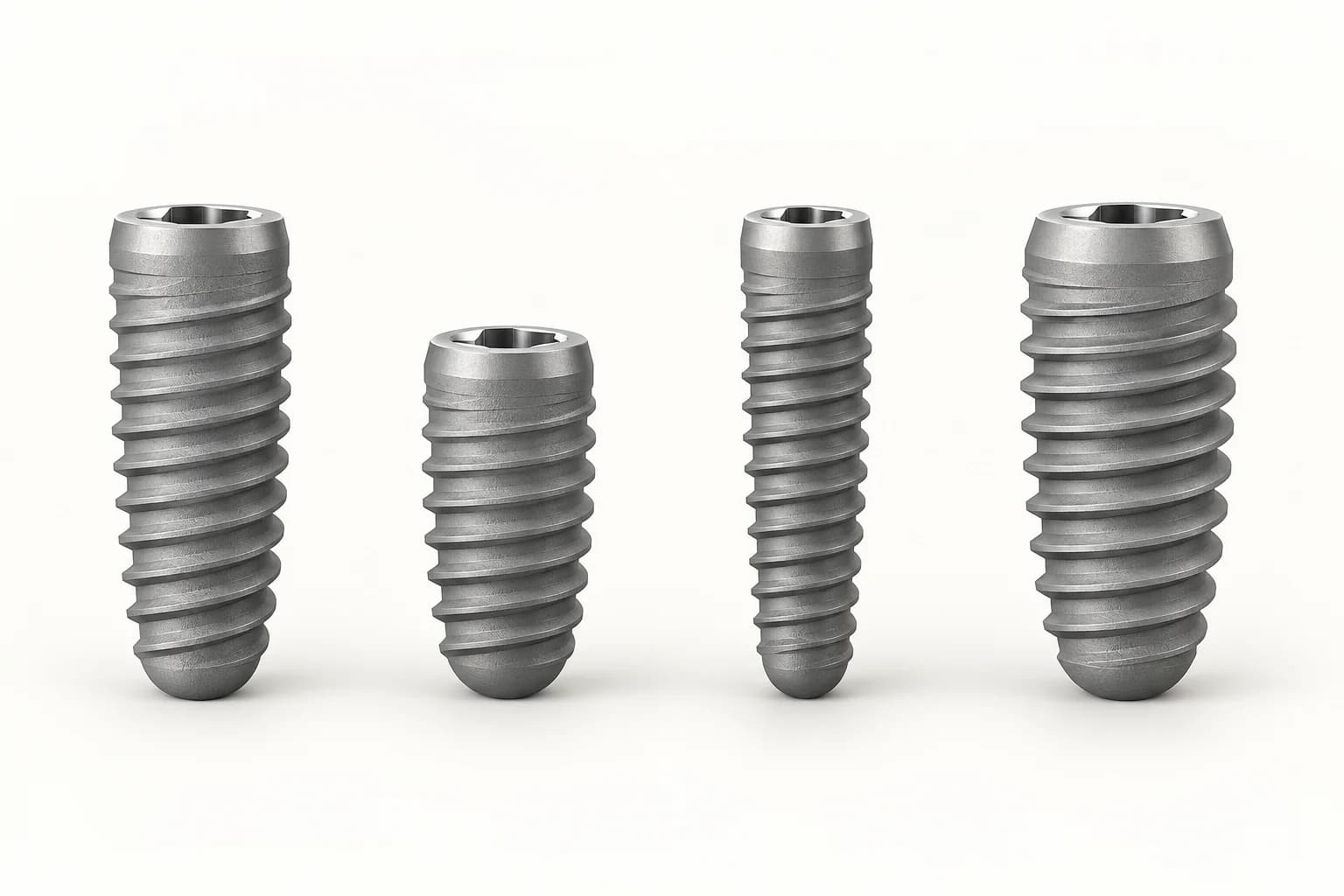
From left to right: a standard example, then a short, a narrow-diameter and a wide-diameter implant. Diameter and length are chosen by assessing the available bone and the tooth to be made together.
AI-generated schematic illustration, not to scale. It does not show a particular brand or real product dimensions.
How Does the Tooth on Top Affect the Choice of Implant?
We assess the system's prosthetic options from the outset so that the tooth to be made on the implant can be designed appropriately, its impression transferred accurately and maintenance carried out when needed. A single tooth, a bridge or a full-arch prosthesis may require different connecting components. What matters is that the system offers the components needed for the planned treatment.
The design of the connection between the implant body and the abutment, the intermediate part that carries the tooth, also plays a role in the choice. There are different connection types and sizes, and parts that look similar are not always compatible with one another. We verify that the components we will use are compatible with the implant model concerned and take into account how the connection system is handled and maintained. We do not regard any single connection type as the best option for every patient. 11
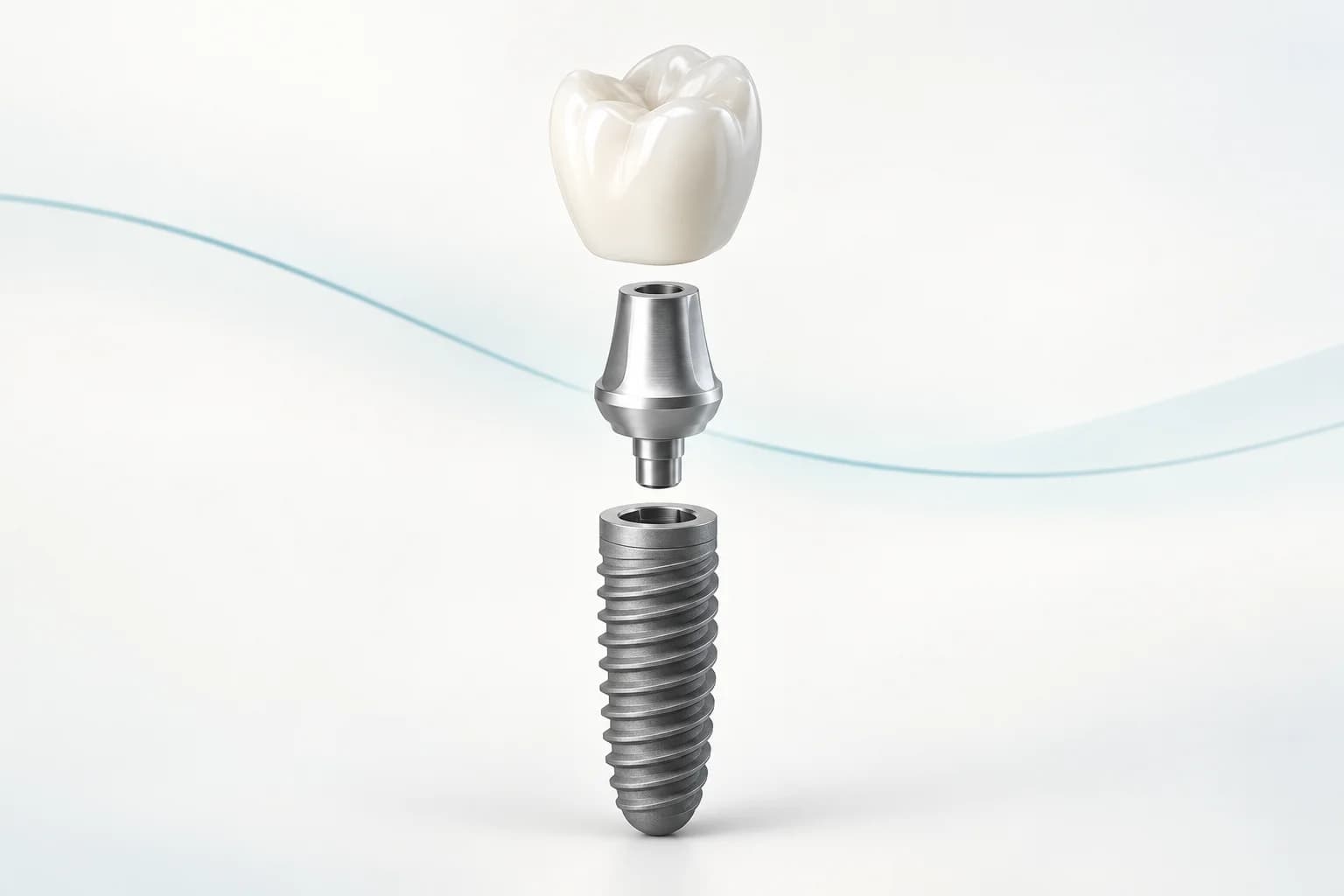
From top to bottom: crown, abutment (the connecting part) and implant body. The parts must be compatible with the chosen implant model.
AI-generated schematic illustration; not a photograph of a real patient or product. Connection designs vary between systems.
Why Does Compatibility with Digital Planning and Impression Systems Matter?
Whether the implant system is compatible with the digital planning, impression and prosthesis design tools we use is also one of our selection criteria. Digital libraries, the digital records of these parts that allow the software to recognise the implant and its components correctly, need to be available. We check support in surgical planning software and in prosthesis design software separately. 16
Particularly when making a full-arch prosthesis on several implants, we may use photogrammetry systems. These use special markers to record the positions of the implants, or of the connecting components on them, relative to one another. In treatments where we plan to use this method, it is important that recording components compatible with the device, and correct digital records, are available for the implant or abutment. 12 17
We do not limit compatibility checks to the brand name; we check the model, connection size, abutment and device-software system together. We complete the position data obtained by photogrammetry with records of the gums, the bite and other intraoral records. In this way, before placing the implant, we also plan how we will take its impression and how we will make the tooth that goes on it.
Are the Implant and the Tooth on It Made of the Same Material?
Implant bodies can be made of materials such as titanium or zirconia. However, the implant in the bone and the tooth made on it are separate parts. When people talk about a “zirconia tooth”, they usually mean the material of the tooth; it does not mean that the implant inside the bone is also ceramic.
We assess the material together with its intended use, design and prosthetic options. Being metal-free does not by itself show that a product is safer or more successful for everyone. We also take known allergies and previous problems with materials into account when planning treatment. 13 15
How Are Maintenance and Component Support Provided Years Later?
Choosing an implant is not only about the day treatment is completed. It also matters that suitable parts can be obtained if the prosthesis needs a repair or a component needs replacing in the future. That is why we regard the system's component support, and keeping records of the products used, as part of the treatment.
An implant card or product record showing the brand, model, diameter, length and production batch number also helps if you need care from another clinician in the future. 15 We assess the component support currently available; no unconditional guarantee can be given for supply many years from now.
Long-term results are also influenced by the patient's general health, oral hygiene and regular check-ups. Choosing a brand is no substitute for follow-up. 14 We cover this process separately in our articles on implant longevity and implant care.
How Can You Take Part in This Choice as a Patient?
You do not need to know every brand, model and surgical detail to choose an implant. Your clinician identifies the suitable options based on the examination and imaging findings; you can take part in the decision by sharing your expectations, your budget and your priorities for the treatment process.
Questions you can ask your clinician
- “Which brand and model do you recommend for me, and why?” You can ask them to explain how the choice relates to your bone and the tooth to be made.
- “Are there other options suitable for my situation?” You can discuss what the alternatives would change in terms of additional surgery, treatment time and the tooth to be made.
- “What is your experience with this system?” You can ask how familiar your clinician is with the surgical procedure and prosthetic components of the system they recommend.
- “Is there long-term follow-up information on this implant model?” You can ask about the results of the proposed product in patients.
- “Is this system compatible with the digital impression and prosthesis production method you are planning?” You can ask whether the necessary impression components and software support are available.
- “How would a part be obtained if one is needed years from now?” You can discuss maintenance, repairs and the possibility of continuing treatment with another clinician.
- “What does the treatment fee include?” You can find out how the implant, the abutment, the tooth to be made, any bone augmentation procedures and check-ups are charged. A low or high price alone does not indicate quality; when comparing quotes, you also need to know what they cover.
- “Will I be given the details of the implant used?” You can ask for an implant card or product records showing the brand, model and manufacturing details.
You can tell your clinician which brand you have in mind and why you prefer it. The key things to consider together are why that system suits your treatment, what the alternatives offer and how long-term maintenance will be provided.
For an appointment and a personal assessment, you can write to us.
References
The clinical information is supported by the academic publications below. The studies differ in their patient groups and methods, so their results should not be read as a guarantee of individual success. Manufacturer documents cited for technical compatibility are not evidence of clinical superiority.
Academic publications
Patient information and technical documents
Related pages
Discuss Your Questions with Dr. Gürel
Your first message goes directly to Dr. Aykut Gürel, who personally handles the initial discussion and appointment planning. You can start by sharing your country, preferred language and any proposed travel dates.
If you are travelling from abroad for treatment, Dr. Gürel plans your visit at Dentopol Ümraniye. The treatment location and appointment are confirmed with you before you travel.
WhatsApp opens a draft; send it to start the conversation. An appointment is confirmed only after Dr. Gürel replies.